Address
Pittsburgh, PA
Work Hours
Monday to Thursday: 9AM - 5PM ET
Friday: 9AM -1PM

Address
Pittsburgh, PA
Work Hours
Monday to Thursday: 9AM - 5PM ET
Friday: 9AM -1PM
For years, product teams have been told the same thing.
Be Agile.
Be Lean.
Move fast.
In theory, these ideas make sense. In practice, they often fail. Not because the frameworks are wrong, but because they are applied without evidence, without users, and without a modern understanding of how products are actually built today.
The most successful companies are not winning because they move faster. They are winning because they learn faster.
This is where modern product discovery comes in.
No email required.
Download the playbook if you want to burn less funding and get more clarity on what you’re building.
Most UX design and product discovery processes were built for a different era.
An era where:
Today, founders, product managers, and UX designers are expected to make high-stakes decisions with fewer resources and tighter constraints. Roadmaps are scrutinized. Engineering time is expensive. Guesswork is punished.
Yet many teams still start initiatives the same way:
This leads to products that ship quickly but miss the mark.
Speed without validation is not efficiency. It is risk.
Modern product discovery is not a phase. It is an operating model.
At its core, it focuses on answering one question as early as possible:
To answer that, high-performing product teams invest in:
This approach allows teams to validate ideas in days instead of months, while dramatically reducing the cost of being wrong.
For startups, this can mean the difference between raising the next round or running out of runway.
For enterprises, it can mean avoiding multi-quarter misfires that drain morale and budget.
AI does not replace UX designers, product designers, or product managers.
It changes the economics of discovery.
AI-assisted workflows allow teams to:
This is not about slapping an AI layer on broken processes. That only accelerates bad decisions. Modern teams use AI to amplify strong fundamentals, not bypass them.
When paired with solid UX strategy, user testing, and rapid prototyping, AI becomes a force multiplier for product teams.
The most valuable work in product design often happens before a single line of production code is written.
UX research helps teams:
This is why many successful SaaS companies treat research as a core investment, not a cost center. In fact, for many high-growth companies, discovery and experimentation represent one of their largest ongoing investments.
They are not betting on luck.
They are betting on evidence.
There is a persistent myth in product teams that research slows things down.
In reality, the opposite is true.
Modern product discovery:
When teams validate concepts early through rapid prototyping and user testing, they move faster later. Engineering teams build with clarity. Stakeholders align around evidence. Roadmaps become more resilient.
This is how high-performing UX agencies and product design consultancies operate today. Not by delivering more artifacts, but by delivering better decisions.
The companies pulling ahead are not guessing better. They are discovering better.
They start initiatives with users in the room.
They test before they scale.
They optimize throughput across the entire product lifecycle.
Much like elite athletes who position themselves where the puck is going, not where it has been, modern product teams design for the future state, not the past.
This is where real business value is created.
No email required.
Download the playbook if you want to burn less funding and get more clarity on what you’re building.
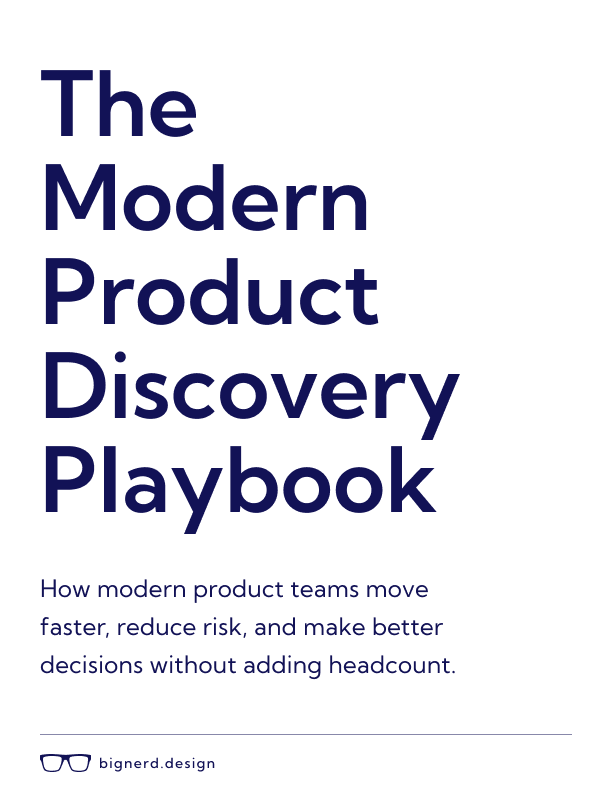
The Modern Product Discovery Playbook exists to help founders, product managers, and UX designers navigate this shift.
It is a practical guide to:
No buzzwords.
No theory without application.
Just a clear, modern approach to building products that work.
If you are not starting every initiative with real users involved, you are gambling.
If you are not optimizing how ideas move from concept to validation, you are leaving value on the table.
Modern product discovery is no longer optional.
It is how strong products are built now.
And it is where the future of UX design, product design, and SaaS innovation is headed.