Address
Pittsburgh, PA
Work Hours
Monday to Thursday: 9AM - 5PM ET
Friday: 9AM -1PM

Address
Pittsburgh, PA
Work Hours
Monday to Thursday: 9AM - 5PM ET
Friday: 9AM -1PM
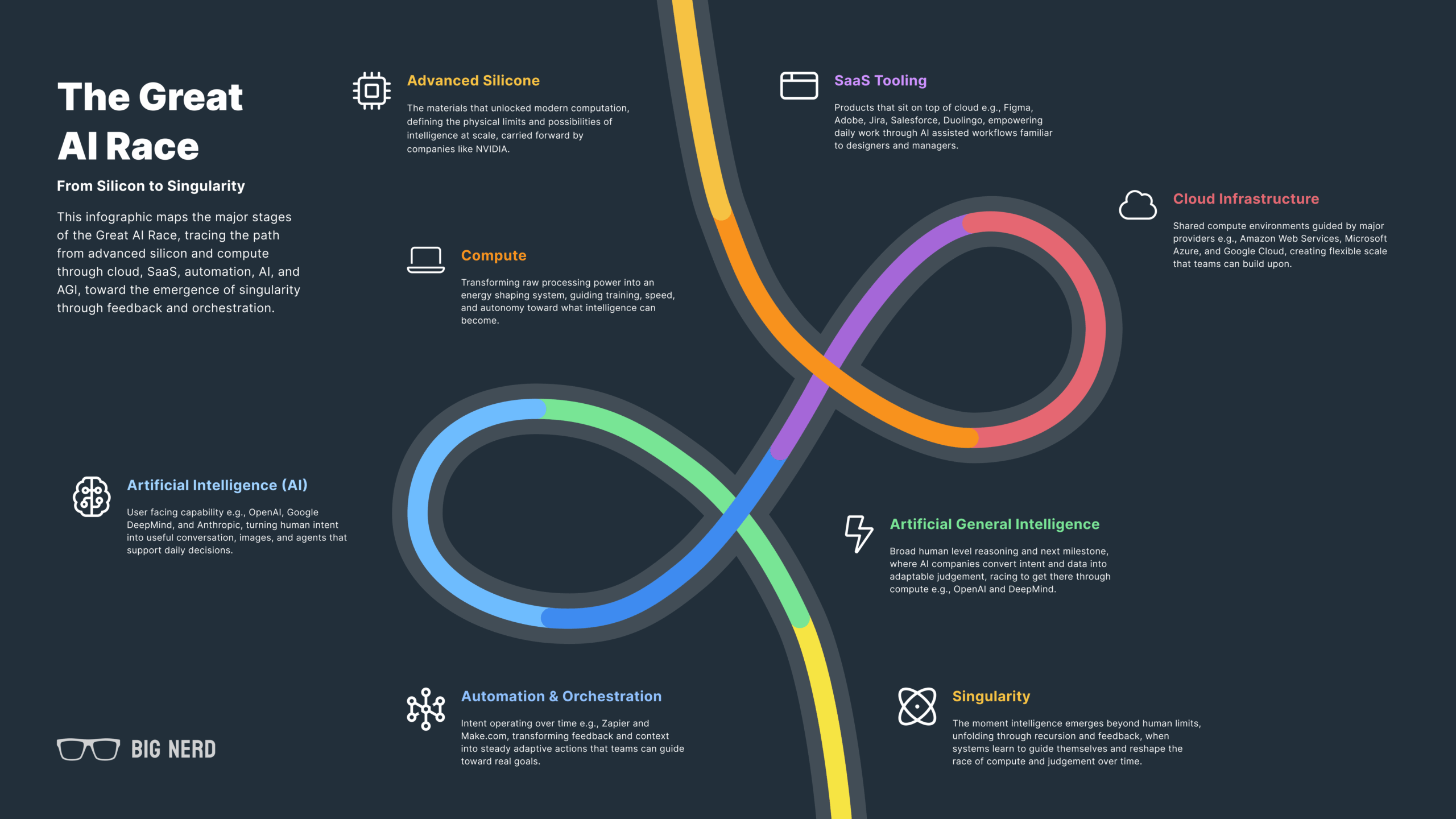
We are living through a rare moment where the foundations of technology are being rebuilt in real time. Artificial intelligence did not arrive all at once. It is emerging through a series of interconnected layers, each compounding the next. Understanding this path is no longer optional for people shaping products, systems, and experiences.
Most conversations about AI focus on tools, prompts, or interfaces. That view is already outdated. Power is shifting beneath the surface, toward infrastructure, orchestration, and feedback loops that operate over time. Designers and product leaders who understand this shift early will have far more agency than those who arrive late.
This article introduces a high-level map of the Great AI Race. Not as a prediction, but as a way to orient ourselves. The goal is not to scare or overwhelm, but to build shared understanding. Because once you can see the system, you can design within it more intentionally.
Every race has a starting line, and for modern AI, it begins with materials. Advanced silicon unlocked modern computation by defining what is physically possible at scale. Chips designed for parallel processing transformed electricity into unprecedented mathematical throughput.
Companies like NVIDIA did not just make faster hardware. They set the physical boundaries within which intelligence could grow. Cost, heat, energy use, and manufacturing capacity all live here. This layer does not think, decide, or adapt, but it quietly determines how far everything above it can go.
For designers, this layer is about constraint awareness. Intelligence is not abstract. It is grounded in atoms, supply chains, and energy.
If silicon defines possibility, compute turns that possibility into motion. Compute is the process of transforming raw processing power into usable capacity. It shapes how fast models can be trained, how responsive systems feel, and how much autonomy is affordable.
At this layer, time becomes leverage. Training cycles shorten. Feedback loops tighten. What once took months can happen in days or hours. This is where intelligence begins to feel alive, not because it understands, but because it can iterate.
Designers rarely touch compute directly, but its effects are everywhere. Latency, responsiveness, and scale are not interface problems. They are compute problems that surface in experience.
Cloud infrastructure gathers compute into shared, flexible environments. Instead of owning machines, teams rent capacity on demand. This abstraction changed who could build advanced systems and how quickly they could scale.
Providers like Amazon Web Services, Microsoft Azure, and Google Cloud turned infrastructure into a service. This unlocked global reach, rapid experimentation, and continuous deployment. It also centralized enormous power in a small number of platforms.
Cloud made intelligence accessible. It also made dependency invisible. Most modern products sit on foundations their users never see.
SaaS tooling is where most people encounter software daily. Products like Figma, Adobe, Jira, Salesforce, and Duolingo sit on top of cloud infrastructure and translate capability into workflow.
AI entered this layer quietly at first. Smart suggestions, automation, copilots, and recommendations. These tools feel familiar, which makes their transformation easy to miss. Yet this is where AI became normal.
For designers, this layer is comfortable ground. But comfort can be deceptive. SaaS is no longer the center of gravity. It is becoming a surface on which deeper systems act.
This is where the shift begins.
Automation and orchestration are about intent operating over time. Instead of single interactions, systems begin to coordinate actions, tools, and feedback loops. Platforms like Zapier and Make.com are early examples, but the pattern is much larger than any one product.
Here, designers stop designing screens and start shaping behavior. What triggers action. How systems recover from error. When humans are looped in or left out. This layer turns capability into momentum.
Orchestration is where intelligence becomes directional. It is also where designers regain leverage, not by drawing more interfaces, but by defining how systems behave across time.
Artificial intelligence is the user-facing expression of all the layers below it. This is where people interact with models through conversation, images, recommendations, and agents.
Companies like OpenAI, Google DeepMind, and Anthropic transformed research into usable products. AI at this layer feels helpful, sometimes surprising, occasionally unsettling. It supports decisions, creativity, and problem solving.
This is also where competition intensifies. AI companies are racing forward, powered by compute, data, and feedback. What looks like magic is actually orchestration plus scale.
Artificial General Intelligence represents the next major milestone. Broad, human-level reasoning that can adapt across domains rather than excel at narrow tasks.
AGI is not here yet, but it is actively pursued. Research labs and companies are racing toward it through compute, architecture, and feedback. The transition from AI to AGI will likely feel incremental until, suddenly, it does not.
This layer matters because it changes assumptions. What needs to be designed. What needs to be supervised. What remains human. The closer systems get to general reasoning, the more important intention, values, and boundaries become.
Singularity is not a product or a feature. It is the point at which intelligence compounds beyond human limits. Systems guide themselves, reshape feedback loops, and evolve faster than we can fully track.
Whether it arrives gradually or abruptly, singularity is an emergent property of everything below it. It unfolds through recursion, not announcement. By the time it is obvious, it may already be normal.
The question is not when it happens, but who understands the system when it does.
This race is not linear. It is layered, recursive, and deeply interconnected. Each phase builds on the last, but the real leverage lives in how they work together.
Designers are not being replaced. They are being repositioned. The future belongs to people who can orchestrate intent across systems, not just polish interfaces.
Understanding this stack now is an advantage. It allows you to see where power is concentrating, where new roles are forming, and where agency still exists.
In the next article, we will zoom in on the major players shaping each layer of this race. Not just who they are, but how they influence the system and where opportunities still remain for individuals and small teams.
This is not about predicting the future. It is about learning to design within it.